


It’s that time of year: days are shorter, temperatures are cooling, and the sweet, earthy smell of fall is in the air. Across the Northeast, trees are bursting into color. What’s the reason behind the changing leaves? And why might this foliage season look different from the last, or the next?
AMC’s Ella Gurney and Jenny O’Connell have been doing some research, and what we’ve found might surprise you. Read on for insights on the science behind the colors you see, how climate change may impact fall colors in the future, and our fall foliage prediction for 2024.
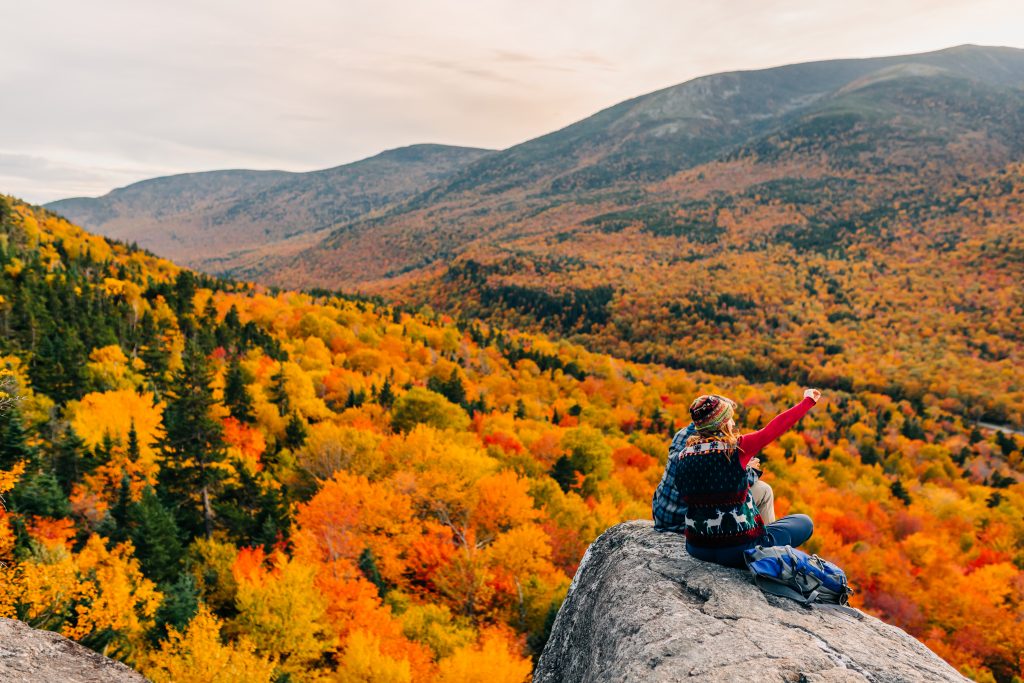
Oct. 4, 2022. Square Ledge, Pinkham Notch, White Mountain National Forest, New Hampshire– Photo by Corey David Photography.
What Makes Trees Change Color?
Though there are a number of factors that impact how vibrant the leaves will be, the real driver of changing foliage each year is a lack of sunlight. September 21st marked the autumnal equinox—the point each fall when day and night are roughly the same length—but as the balance tips toward darkness, deciduous trees (trees that shed their leaves) like aspen, birch, maple, and oak get the message that it’s time to start storing energy for winter.
If a tree were an AMC lodge, the leaves would be the kitchen—the place where food is made. The Croo making the food would be chlorophyll, the extraordinary chemical that uses the sun’s energy to convert carbon dioxide and water into sugars and starch, which are then shuttled from the leaves to the rest of the tree. Chlorophyll is green in color, so while it’s at peak power during the spring and summer, it masks the other colors hidden in the leaves. But when days shorten and temperatures drop, a thick layer of cells develops at the base of the leaf stems, sealing the nutrients inside the tree trunk. As the leaves stop making food, chlorophyll gets broken down and the green color fades, leaving room for chemicals like carotenoids, which turn leaves bright orange and yellow, and anthocyanins, which create reds and purples.
As for the brightness of the leaves? We’ve got sugar to thank for that! Sugars trapped in the leaves create vivid colors, which are enhanced by exposure to sun. (This is why foliage appears brighter after a string of sunny days, and muted in rain or haze.)
Climate Change’s Impact on Fall Foliage
Temperature, precipitation, sunlight, and moisture all have an impact on how bright the leaves will get each fall. A wet-enough summer followed by a dry autumn and cold weather that stays above frost temperatures will produce the most brilliant foliage. On the other hand, early frost or a late summer drought can trigger the trees to start storing nutrients early, which will result in more muted colors. Too much moisture can cause leaves to form brown spots and drop off trees earlier than usual, so they may only become yellow or speckled with color instead of warm, rich oranges or reds. Wildfire smoke can impact how much sun the leaves receive, slowing down photosynthesis and contributing to a shorter foliage season and less vibrant colors.
If you think back to fall 2023, it wasn’t a great year for foliage. A rainier summer than usual, wildfire smoke and haze, and higher-than-average temperatures all contributed to leaves not fully changing color before they fell, leading to a duller foliage season and an overall lack of colors beyond yellow and orange. Reds and purples take longer to show, so the impacts of the summer’s extreme weather diminished those colors in the foliage. These are just a few examples of how climate change impacts our day-to-day in ways we might not even consider.
Predictions for Fall 2024
This summer was not as wet and hazy (though we still had more rain than average and an impactful wildfire season), which speaks well for the foliage! We did see higher-than-average temperatures again, and this is expected to continue into the future due to the impacts of climate change.
The Old Farmer’s Almanac is predicting a tremendous fall foliage season. Given that our weather conditions this past summer were much better than summer 2023, we have to agree that this year will probably be much brighter. Different areas will have been impacted by place-specific weather conditions, so check out our fall foliage tracker to see where you will have the best chance of glimpsing some brilliant fall colors, and when to catch the leaves at their peak!